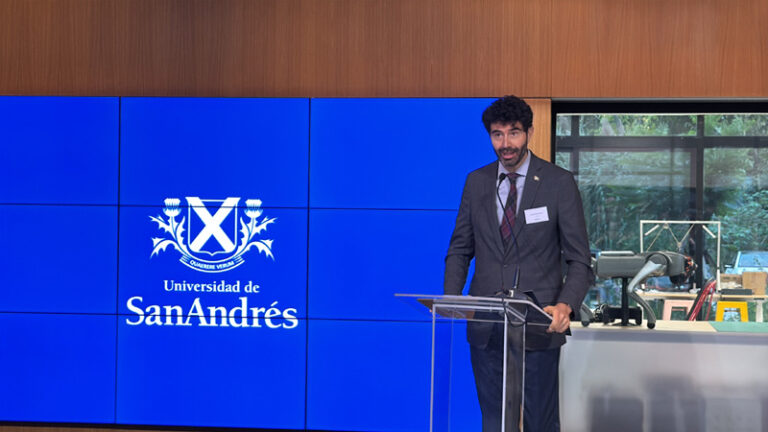
President Javier Milei delivered an economic lecture at the Universidad de San Andrés on Monday, May 18, 2026. The appearance followed a large-scale Federal March regarding university budget laws. During his remarks, the President reaffirmed his administration’s commitment to maintaining fiscal surplus as a permanent state policy amid ongoing tensions with public universities.
Economic Policy Address at Universidad de San Andrés
On Monday, May 18, 2026, President Javier Milei visited the Universidad de San Andrés to present an analysis of his administration’s economic measures. The event took place against a backdrop of significant national unrest, specifically following the fourth Federal March organized to demand compliance with university budget legislation.
The President utilized the platform to highlight the administration’s recent fiscal performance. According to government data, the National Public Sector recorded a primary surplus of $632.844 million and a financial surplus of $268.103 million during April 2026. These figures contribute to a cumulative surplus for the first four months of 2026, reaching approximately 0.5% of the GDP for the primary balance and 0.2% of the GDP for the financial balance.
During the session, which was attended by students and faculty, the President elaborated on the methodology behind his fiscal adjustments. The presentation focused on the transition from a deficit-based model to one centered on the accumulation of fiscal surpluses. The President argued that this shift is the foundational element required to stabilize the national economy and curb inflation. The discussion at the university served as an opportunity for the administration to frame its austerity measures not as a temporary crisis response, but as a long-term structural transformation of the Argentine state.
Fiscal Strategy and Public Communication
Following the lecture, President Milei reiterated his economic stance on social media. Addressing the results announced by Minister of Economy Luis Caputo, the President characterized his fiscal approach as a structural commitment rather than a temporary measure.
The fiscal surplus is a permanent state policy.
President Milei LectureJavier Milei: President of Argentina – Freedom, Economics, and Corruption | Lex Fridman Podcast #453
Javier Milei, President of Argentina
The administration maintains that this fiscal discipline is achieved through a strict control of public spending. Officials stated that the resulting savings allow for the return of resources to the private sector, primarily through the reduction of taxes. This narrative of a V-shaped economic recovery, which the President previously suggested would experience its most difficult period between March and April 2026, remains a central pillar of his communication strategy as he navigates the ongoing conflict regarding university funding.
The Minister of Economy, Luis Caputo, has consistently supported this narrative, providing the technical data that underpins the President’s public assertions. According to the data provided by the Ministry of Economy, the surplus achieved in April represents a critical milestone in the administration’s stated objective of eliminating the fiscal deficit. This statistical output is frequently cited by the executive branch to counter criticisms regarding the social impact of the budget cuts.
Context of the University Conflict
Federal March Protesters
The President’s engagement at the private university occurred during a week marked by intense public scrutiny regarding the funding of the national university system. The recent mass mobilization, known as the fourth Federal March, highlighted widespread concerns over the implementation of the University Budget Law.
While the President focused his Monday address on economic metrics and the success of his fiscal adjustment program, the broader social environment remains strained by the dispute over state allocations for public education. The administration has signaled that it intends to continue its course of austerity, with the President scheduled to provide further commentary on labor market insertion on Tuesday, May 19, 2026.
University representatives and student organizations involved in the fourth Federal March have expressed disagreement with the government’s prioritization of fiscal surpluses over increased funding for public institutions. These groups argue that the current budget levels are insufficient to cover operational costs, salaries, and research initiatives. The administration, however, maintains that the resources must be managed with strict oversight to ensure that the national budget remains in balance.
The government’s position remains that maintaining the current fiscal trajectory is essential for long-term economic stability, despite the challenges presented by organized protests and the specific demands of the public university sector. As of Monday, the administration has not indicated a shift in its budget enforcement policies, emphasizing instead the statistical achievements of the first four months of the year. The tension between the executive branch’s fiscal goals and the demands of the university sector continues to define the current political landscape, with the President utilizing public appearances and academic forums to consolidate support for his ongoing economic reform agenda.