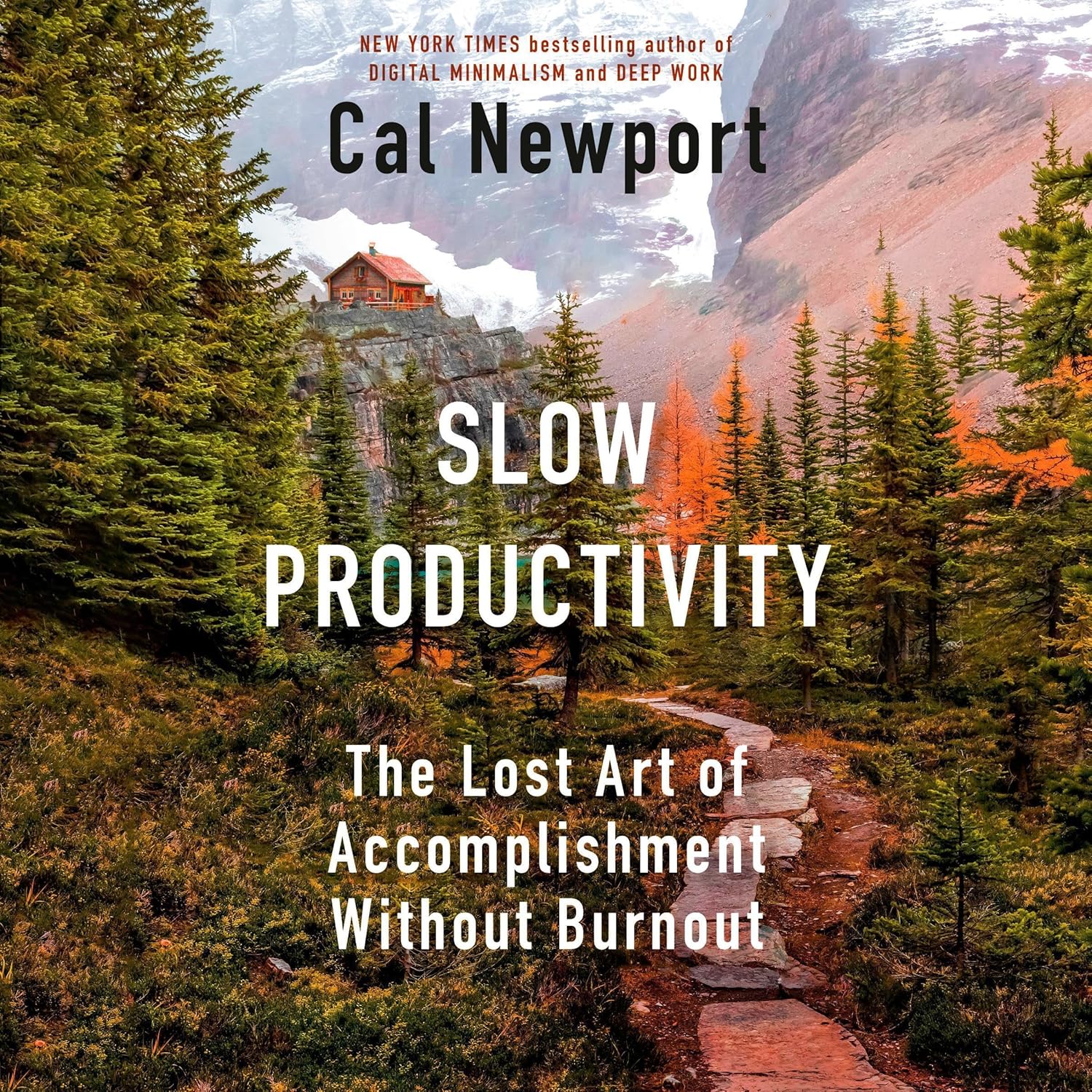
Computer scientist Cal Newport, author of bestsellers like *Deep Work* and *Digital Minimalism*, now rejects the modern obsession with productivity, calling its core definition “broken” in recent interviews and essays.
The Productivity Guru Who Turned Against Productivity
Eight years after publishing *Deep Work* in 2016, Cal Newport—the Georgetown University professor who became a global authority on focus and efficiency—has abandoned his own framework. In a series of interviews and essays published this year, he argues that the very concept of productivity, as it’s understood in knowledge work, is flawed. His reversal reflects a broader reckoning in 2026 over how organizations measure and exploit labor, particularly in the digital economy.
Newport’s critique centers on what he calls the “visible activity fallacy”: the assumption that productivity can be gauged by how busy someone appears, rather than by tangible outcomes. In a 2026 analysis for *Xataka* (translated from Spanish), he writes that this approach—rooted in industrial-era metrics—has been weaponized by employers to justify endless work without addressing systemic inefficiencies. “We’ve replaced meaningful measurement with a grotesque approximation,” he states.
His shift began around 2024, when he noticed a disconnect between his own advice and the realities of modern work. While *Deep Work* (2016) and *Digital Minimalism* (2019) framed productivity as an individual skill, Newport now argues that the problem lies in how organizations design work itself. “The definition of productivity is broken,” he told *Harvard Business Review* in January 2026, emphasizing that the issue isn’t personal discipline but structural misalignment.
—
The Flaws in the Factory Model
Newport’s earlier work drew on Henry Ford’s assembly-line efficiency, but by 2026, he rejects that analogy for knowledge work. In the 20th century, productivity was straightforward: more widgets per hour. But for software engineers, writers, or researchers, output is intangible—ideas, code, or reports—and thus harder to quantify.
- Misplaced metrics: Tools like Slack messages or meeting minutes are treated as proxies for progress, even though they correlate poorly with actual achievement.
- Overhead inflation: Workers spend more time documenting and coordinating than creating, a trend he calls “the productivity paradox.”
- False accountability: Employees are blamed for inefficiency when the real issue is poorly designed workflows.
In a 2026 essay for *Xataka*, Newport cites a 2025 study by the Lean Institute Colombia, which found that 63% of white-collar workers’ time is spent on “busywork”—tasks that create the illusion of productivity without delivering value. “We’ve optimized for motion, not motion with purpose,” he writes.
His solution? Abandoning individualistic productivity hacks in favor of systemic change. “The problem isn’t you,” he argues. “It’s the system that rewards you for being busy, not for being effective.”
—
From Self-Help to Structural Critique
Newport’s evolution mirrors a broader backlash against productivity culture. By 2026, critics—from labor economists to tech ethicists—are questioning whether the pursuit of efficiency has become its own trap. A 2025 *Harvard Business Review* article noted that companies obsessed with “output metrics” often stifle innovation, while employees report higher burnout despite longer hours.
Newport’s shift is personal. In 2024, he admitted in a *New York Times* interview that he had “burned out” despite his own advice. “I was doing everything right—deep work, minimalism—and still, the system was grinding me down,” he said. That experience led him to re-examine the roots of modern work design.
His latest book, *The Productivity Trap* (2026), argues that the real crisis isn’t laziness but a “productivity industrial complex” that profits from keeping workers perpetually busy. “The tools we use to measure productivity were designed for an economy that no longer exists,” he writes. “We’re using a 1950s playbook to solve 2020s problems.”
—
What Comes Next?
Newport’s reversal has sparked debate. Some productivity coaches dismiss his critique as “anti-work rhetoric,” while labor advocates praise it as long-overdue. In 2026, his ideas are gaining traction in corporate circles, where executives are increasingly open to redesigning workflows rather than blaming employees.
Yet challenges remain. As *HBR* noted in January 2026, “Most organizations lack the data—or the will—to rethink productivity from the ground up.” Without structural changes, Newport warns, the cycle of overwork and under-delivery will persist.
For now, his message is clear: The productivity crisis isn’t a personal failure. It’s a systemic one—and fixing it requires more than better to-do lists.
—
Sources: Xataka (2026), Harvard Business Review (Jan–Feb 2026), Lean Institute Colombia (2026).