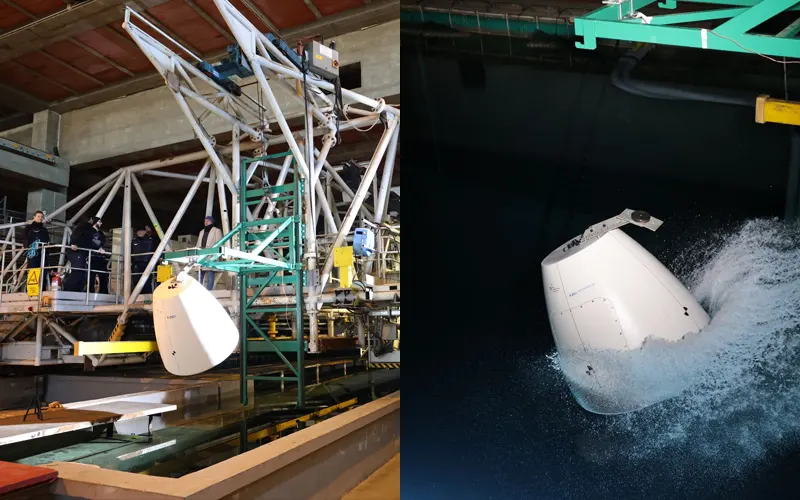
The Exploration Company, a European space startup, successfully completed a critical drop test of its Nyx spacecraft on June 4, 2026, in Mojave, California, as it advances toward a planned 2028 mission to the International Space Station. The test validated key components of the parachute recovery system, marking a pivotal step in the company’s development of a reusable space capsule. The achievement underscores the growing role of private enterprises in space exploration, a trend highlighted by recent milestones in commercial spaceflight.
A Critical Milestone in Spacecraft Development
The Exploration Company’s Nyx capsule underwent a drop test in Mojave, California, on June 4, 2026, to evaluate its parachute recovery system. This test, described as “critical” by the company, confirmed the system’s ability to safely decelerate the spacecraft during re-entry. The results position the Nyx capsule closer to its target launch date of 2028, with the goal of transporting payloads to the International Space Station. The company’s progress aligns with a broader shift in space exploration, where private firms increasingly complement government-led initiatives.
The test’s success follows earlier milestones, including water-impact trials in 2025 and the completion of a key testing phase for its Mission Possible capsule in December 2024. These steps demonstrate the company’s commitment to modular, cost-effective space technology. “The Exploration Company’s achievements reflect a new era of innovation in aerospace,” a spokesperson noted, though the company did not provide further details on the test’s technical specifics.
The Evolution of Exploration: From Ancient Journeys to Modern Missions
Exploration, as defined by scienceinsights.org, is “the deliberate act of venturing into unfamiliar territory” to reduce uncertainty. This concept, rooted in human history, spans from early migrations across open oceans to modern space travel. The Exploration Company’s Nyx capsule embodies this enduring drive, merging ancient curiosity with cutting-edge engineering. The company’s 2028 mission aims to bridge the gap between terrestrial exploration and orbital operations, a goal that echoes the spirit of past discoveries.
Historically, exploration has been fueled by both necessity and ambition. The European Age of Discovery, for instance, was driven by economic motives, while today’s space ventures often prioritize scientific and commercial gains. The Exploration Company’s focus on reusable spacecraft aligns with this dual purpose, offering a sustainable approach to space travel. “Exploration is not just about reaching new frontiers—it’s about creating systems that make future journeys possible,” a researcher from the American Journal of Physical Anthropology wrote in a 2025 study.
Defining Exploration: Language, Legacy, and Innovation
Definitions of exploration, as found in the Cambridge Dictionary and Dictionary.com, emphasize its role in uncovering the unknown. The Cambridge Dictionary highlights “active exploration of space by moving through it,” while Dictionary.com traces the term’s origin to Latin, where it meant “examination” or “search.” These linguistic roots mirror the technical rigor of modern space missions, where every test and launch is a form of systematic inquiry.
The Exploration Company’s work also intersects with broader cultural narratives. The company’s name and mission resonate with the themes of discovery seen in works like Jared M. Diamond’s *Guns, Germs, and Steel*, which explores how human migration shaped history. Similarly, the Nyx capsule’s design reflects a commitment to “searching out, examined” the challenges of space travel, a phrase etymologically linked to the word “exploration” itself.
What’s Next for The Exploration Company?
The Nyx capsule’s upcoming 2028 mission could redefine commercial spaceflight, offering a reusable alternative to traditional spacecraft. The company’s progress is part of a global trend, with rivals like AnduraX Pvt. Ltd. also advancing reusable space technologies. However, challenges remain, including regulatory hurdles and the need for reliable propulsion systems. Benchmark Propulsion, a partner in The Exploration Company’s Mission Possible program, has emphasized the importance of “stable in-orbit operations” as a precursor to crewed missions.

As private companies push the boundaries of space exploration, the line between government and commercial efforts continues to blur. The Exploration Company’s success in Mojave signals a shift toward a future where private innovation drives humanity’s next great adventure. Whether this vision becomes reality will depend on continued investment, technical breakthroughs, and the enduring human desire to explore the unknown.
Source 1 | Source 2 | Source 3 | Source The Exploration Company's success in Mojave signals a shift toward a future where private innovation drives humanity's next great adventure, and its influence will likely be felt for years to come.