
Two teams of scientists have cracked a long-standing puzzle in catalysis: how to design materials that dynamically reshape themselves to become more efficient at producing green hydrogen. One breakthrough, led by researchers at the University of Nottingham, reveals that platinum-nickel nanoparticles can split and reform in real time—defying thermodynamic expectations—while another study from India and Germany shows that molybdenum carbide reconstructs itself during water-splitting reactions, boosting performance. Both discoveries could redefine clean energy production by unlocking catalysts that adapt on the fly.
A Catalyst That Rewrites Itself: The Nottingham Breakthrough
In a discovery that challenges decades of chemical orthodoxy, researchers at the University of Nottingham have observed platinum-nickel nanoparticles reversibly reshaping their atomic structure mid-reaction, creating a hybrid interface between platinum metal and nickel oxide. The finding, published in Advanced Materials, suggests that catalysts aren’t static—they can dynamically reorganize to become more effective at splitting water into hydrogen and oxygen.
The team, led by Dr. Jesum Alves Fernandes in the School of Chemistry, began with nanoscale particles containing just a few dozen platinum and nickel atoms. Under an electron microscope, they expected to see a stable alloy—but instead, the metals separated within seconds, forming two distinct halves: one rich in platinum, the other nickel oxide, separated by an atomically precise boundary. “This was an astonishing observation,” said Dr. Emerson Kohlrausch, who led the experimental work. “It appeared to go against conventional thermodynamic behaviors.”
“What makes this discovery exciting is that we can reversibly tune the structure of the particle while directly observing the process at the atomic scale. This opens a new strategy for designing adaptive catalysts for a wide range of applications.”
The key to capturing this transformation lay in controlling the electron beam during microscopy. By using a graphene sheet to support the nanoparticles and meticulously adjusting the energy and flux of the electron beam, the researchers could track every atomic movement in real time. As Professor Andrei Khlobystov, a nanomaterials expert at Nottingham, explained, the separation wasn’t random: the nickel atoms migrated to the surface, where they reacted with oxygen to form nickel oxide, while the platinum remained as a metallic core. “We create new types of hybrid particles and observe their formation in real time, which is unprecedented,” he said.
Why does this matter? Traditional catalysts are designed with fixed structures, assuming they’ll perform consistently. But the Nottingham team’s work suggests that the most active catalytic phase often emerges during the reaction itself. By tuning the atomic arrangement on demand, scientists could engineer catalysts that adapt to the conditions of the reaction, potentially slashing the cost and improving the efficiency of green hydrogen production.
Molybdenum Carbide’s Hidden Transformation: The India-Germany Study
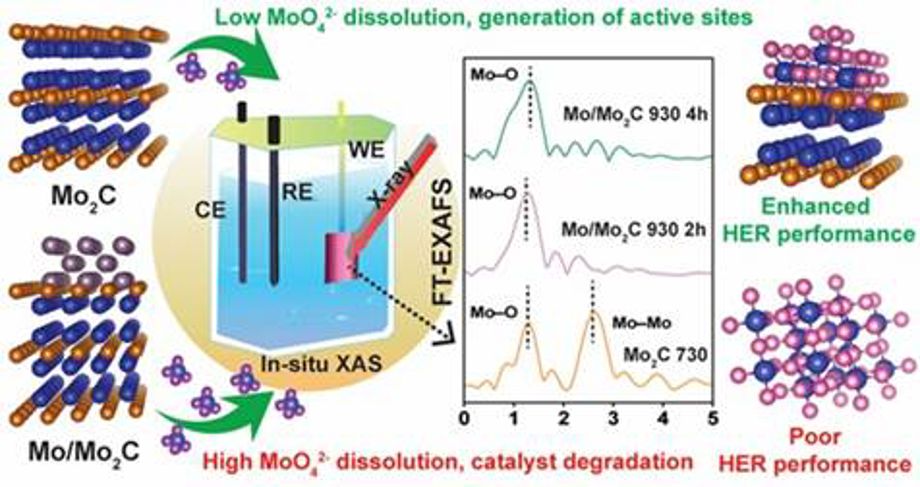
Meanwhile, a separate study from Indian and German researchers has uncovered a similar dynamic in molybdenum carbide (Mo₂C), a low-cost, earth-abundant catalyst long assumed to be structurally stable. Led by Dr. Neena S. John at the Centre for Nano and Soft Matter Sciences (CeNS) in Bengaluru, the team used in situ X-ray absorption spectroscopy (XAS) and Raman spectroscopy to watch Mo₂C reconstruct itself during the hydrogen evolution reaction (HER). What they found was a catalyst that doesn’t just endure the reaction—it transforms to become better at its job.

The study, published by the Department of Science & Technology (DST), revealed that Mo₂C doesn’t remain static. Instead, it forms oxygen-deficient molybdenum oxide domains during HER, closely resembling MoO₂—a structure that enhances catalytic activity and stability. The transformation wasn’t a flaw; it was a feature. “This dynamic reconstruction is beneficial,” the DST report noted, “leading to improved activity and stability.”
The contrast with Mo/Mo₂C heterostructures was stark: while the pure Mo₂C adapted beneficially, the heterostructures oxidized too rapidly, forming soluble molybdate species that deteriorated performance. The takeaway? Controlled reconstruction boosts efficiency, while uncontrolled oxidation destroys it. This insight could help engineers design catalysts that self-optimize under operating conditions, rather than relying on rigid, pre-engineered structures.
The Common Thread: Catalysts That Evolve
Both studies upend a fundamental assumption in catalysis: that materials should be designed to remain unchanged. Instead, they suggest that the most effective catalysts may be those that can reshape themselves in response to their environment. The Nottingham team’s platinum-nickel nanoparticles and the CeNS-led Mo₂C research share a critical insight: atomic-level restructuring isn’t a bug—it’s a feature.
Historically, catalysts were treated as static tools—like a wrench that stays the same shape whether you’re tightening a bolt or loosening one. But these discoveries imply that the best catalysts might behave more like living systems, adapting their structure to optimize performance. The Nottingham team’s ability to observe and control this process in real time—using graphene-supported nanoparticles and precise electron beam tuning—could be a blueprint for future catalyst design.
Similarly, the Mo₂C study demonstrates that real-world operating conditions can trigger beneficial transformations. By tracking the catalyst’s behavior during HER, the researchers identified that the active phase—the most effective form of the catalyst—emerges during the reaction itself. This challenges the traditional approach of pre-engineering catalysts to match a static ideal.
What’s Next: From Lab to Industry
The implications for green hydrogen production are profound. Today’s most efficient catalysts—often made from rare and expensive metals like platinum—could be replaced or augmented by adaptive, self-optimizing materials. The Nottingham team’s work suggests that by engineering nanoparticles to separate and reform under specific conditions, scientists could create catalysts that are both cheaper and more efficient.

Yet challenges remain. Scaling these discoveries from the lab to industrial production will require overcoming hurdles like controlling the atomic-level transformations at scale and ensuring the catalysts remain stable over thousands of hours of operation. The Nottingham team’s reliance on graphene-supported nanoparticles and precise electron beam control may not translate directly to large-scale manufacturing. Similarly, the Mo₂C study’s findings will need validation in real-world electrolyzers to confirm their durability.
Still, the potential is clear. If catalysts can be designed to adapt on the fly, the cost of green hydrogen could plummet, making it competitive with fossil fuels. The Nottingham breakthrough, published in Advanced Materials, and the CeNS-led Mo₂C research, highlighted by the Department of Science & Technology, represent two sides of the same coin: the future of catalysis may lie in materials that don’t just work—they evolve.
Why This Matters: A Shift in How We Think About Catalysts
The traditional view of catalysts—as inert, unchanging materials—has limited progress in clean energy. These new findings suggest that the most promising catalysts may be those that can reshape themselves in response to their environment. This isn’t just a technical tweak; it’s a paradigm shift.
Consider the economic impact: platinum is one of the most expensive metals used in catalysis, with prices fluctuating wildly. If adaptive catalysts can achieve similar—or better—performance with cheaper materials like nickel or molybdenum, the cost of green hydrogen could drop dramatically. The Nottingham team’s work, for example, shows that platinum and nickel, when dynamically rearranged, can outperform traditional platinum-rich alloys. Similarly, Mo₂C’s ability to self-reconstruct into a more active form could make it a viable alternative to rare-metal catalysts.
Beyond hydrogen, the implications extend to batteries, fuel cells, and even carbon capture technologies. If catalysts can be designed to optimize their structure during operation, entire industries could see breakthroughs in efficiency and sustainability. The key question now is whether these lab-scale discoveries can be scaled up without losing their adaptive properties.
One thing is certain: the era of static catalysts may be ending. As Dr. Fernandes put it, “we can reversibly tune the structure of the particle while directly observing the process at the atomic scale”. That level of control—once thought impossible—could redefine not just hydrogen production, but clean energy as a whole.
For now, the scientific community is watching closely. The Nottingham team’s real-time atomic observations and the CeNS-led study’s dynamic reconstruction insights suggest that the next generation of catalysts won’t just be better—they’ll be alive, adapting to their environment in ways we’re only beginning to understand.